 ΒΟΗΘΟΣ ΦΡΟΝΤΙΔΑΣ
 EL
ELThe absorbent core: superabsorbent and cellulose
This is the layer that holds the liquid. Its capacity, speed and behaviour under pressure depend on the superabsorbent / cellulose pair and on how they are blended.
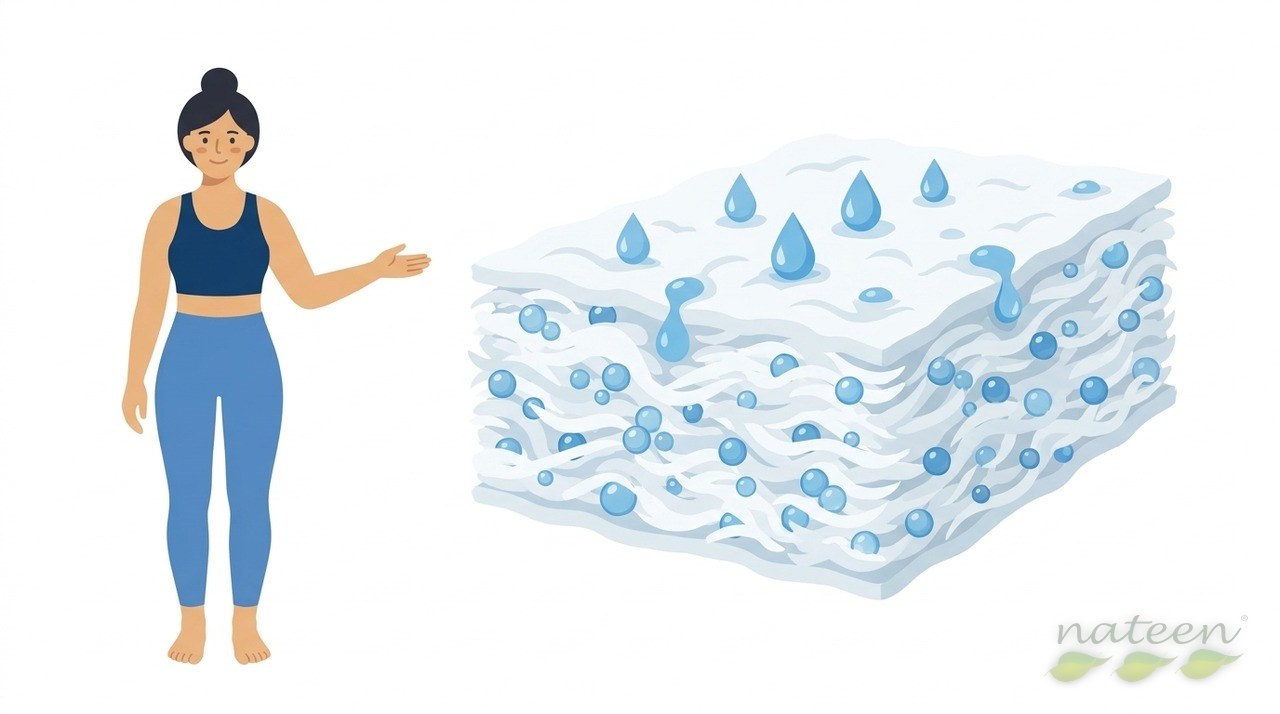
Two materials, three performances
The core of a protection is a mat of defibred cellulose in which grains of superabsorbent polymer, SAP, are dispersed. Cellulose captures quickly and spreads the liquid; SAP holds it durably by forming a gel.
Three measures describe this core: maximum capacity (how much it holds), rate of absorbency or ROA (how fast it accepts a void), and rewet (what comes back toward the skin under pressure). A good core balances the three, and the balance is set in the laboratory, not in an argument.
Why Nateen combines several SAPs
Not all superabsorbents have the same kinetics. Some grains swell very fast but saturate early; others hold more but more slowly. We combine several grades of SAP in the same core to get both a good absorption speed and a low rewet, without giving up capacity.
The share of cellulose is set the same way. Too little, and the liquid is not distributed fast enough; too much, and the product gets thick without absorbing more. Each range has its own proportion.
One core, or two
On night and high-capacity products, two stacked cores or a dual-density core share the load and limit gel blocking: a gel too compact at the surface that would stop the next void from passing.
Quality-controlled superabsorbents chosen for their kinetics and combined per range, pure first-grade cellulose, and a proportion set on the test bench for every reference.
- Capacity, speed and rewet are measured separately.
- Blending several SAPs improves the balance between speed and retention.
- The cellulose percentage is set, not guessed.
These pages describe materials and test methods in general terms. The exact characteristics of each product are on its technical sheet; they evolve with our laboratory work.